How to have your chocolate and to eat it too?
Reflection from Katherine Ding
How to have your chocolate and to eat it too?
This is the question on my mind as the first round of chocolates appear, nestled in mini cupcake liners on a wooden coaster the size of my palm. To be here—in the woods for a weekend, savoring ten rounds of chocolate and tea—I left three young kids behind with my partner. He’ll need to navigate the meals the boys refuse to eat without me, two sleepless nights, the disruption of our well-greased schedule. How do I bring them a taste of this experience that he has made available for me?
The chocolate pieces are small and uneven. For each round of tasting, a single bar—meticulously sourced and painstakingly crafted over several days—is broken apart by hand to be shared among thirty mouths. As volunteers walk around the circle distributing the chocolate, I wonder if I’ll get the bigger piece.
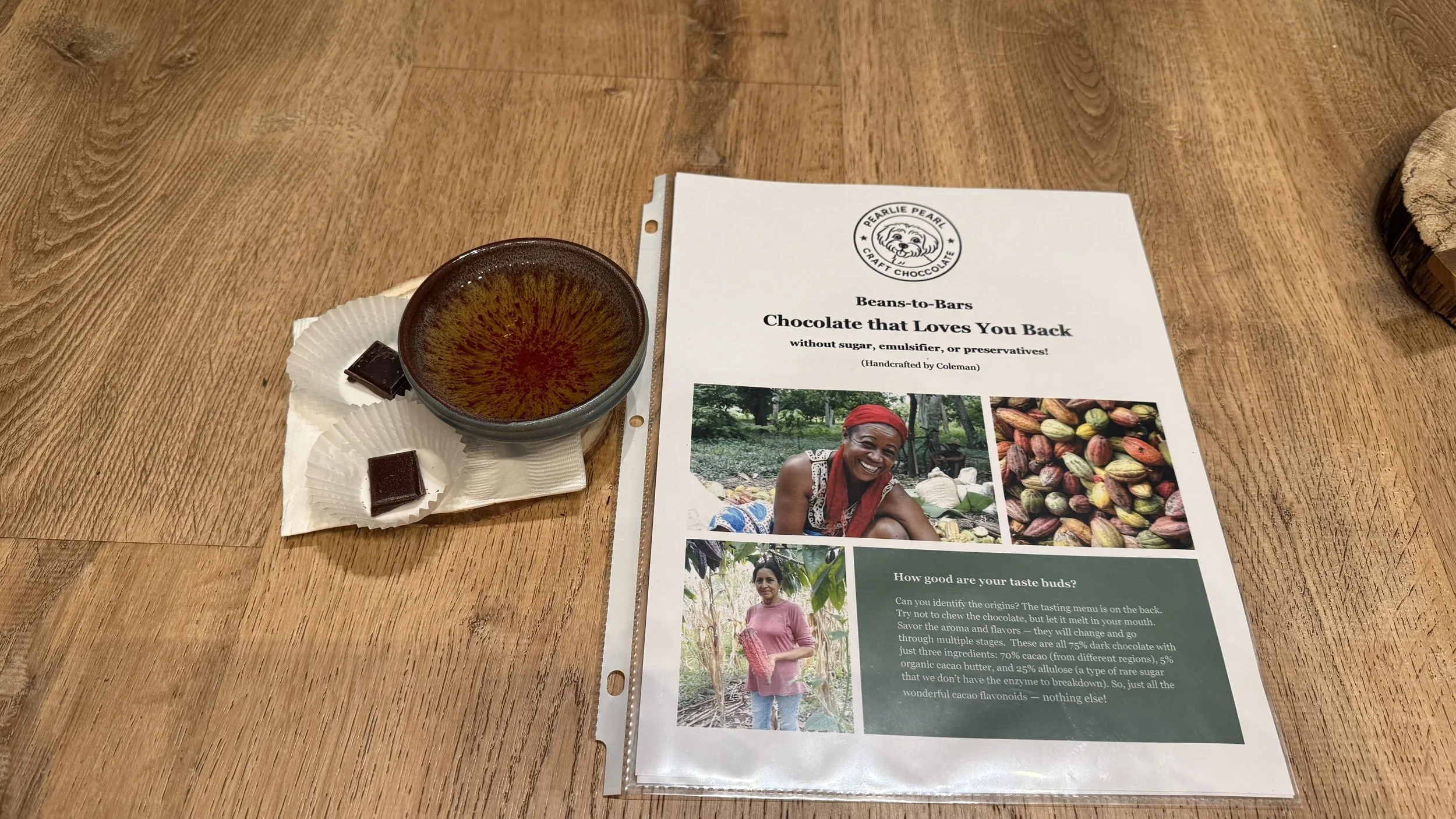
The desire for bigger is a familiar, old habit. But by the second round of tastings, I realize that bigger and smaller as measured by my envious eyes do not apply here. Instead, we had to learn how to savor. For each tasting, I’d break the chocolate in half and save a piece for Tony and the boys. It wasn’t a hard decision, nor a sacrifice. Coleman instructs us to eat the chocolate slowly, to not chew and let it sit on the tongue until it melts, allowing the nuanced flavors to reveal themselves. Since it’s mostly the thickness and not the length of the piece that determines the melting rate, it takes almost as much time for a smaller piece to melt as a larger one. “Bigger” in this context is not really the advantage that a mathematical comparison might make it out to be. The enjoyment arises from the attentiveness you can give as favors unfurls on the tongue. You’d miss the experience if you are distracted by the desire for a bigger piece.
Evening tasting second day. Why is the person next to me not eating his chocolate? I discover the answer as we get up to leave. He hands me a cupcake liner filled with two pieces. I noticed that you were saving your chocolate for your children, he said. Here’s some more to give to them.
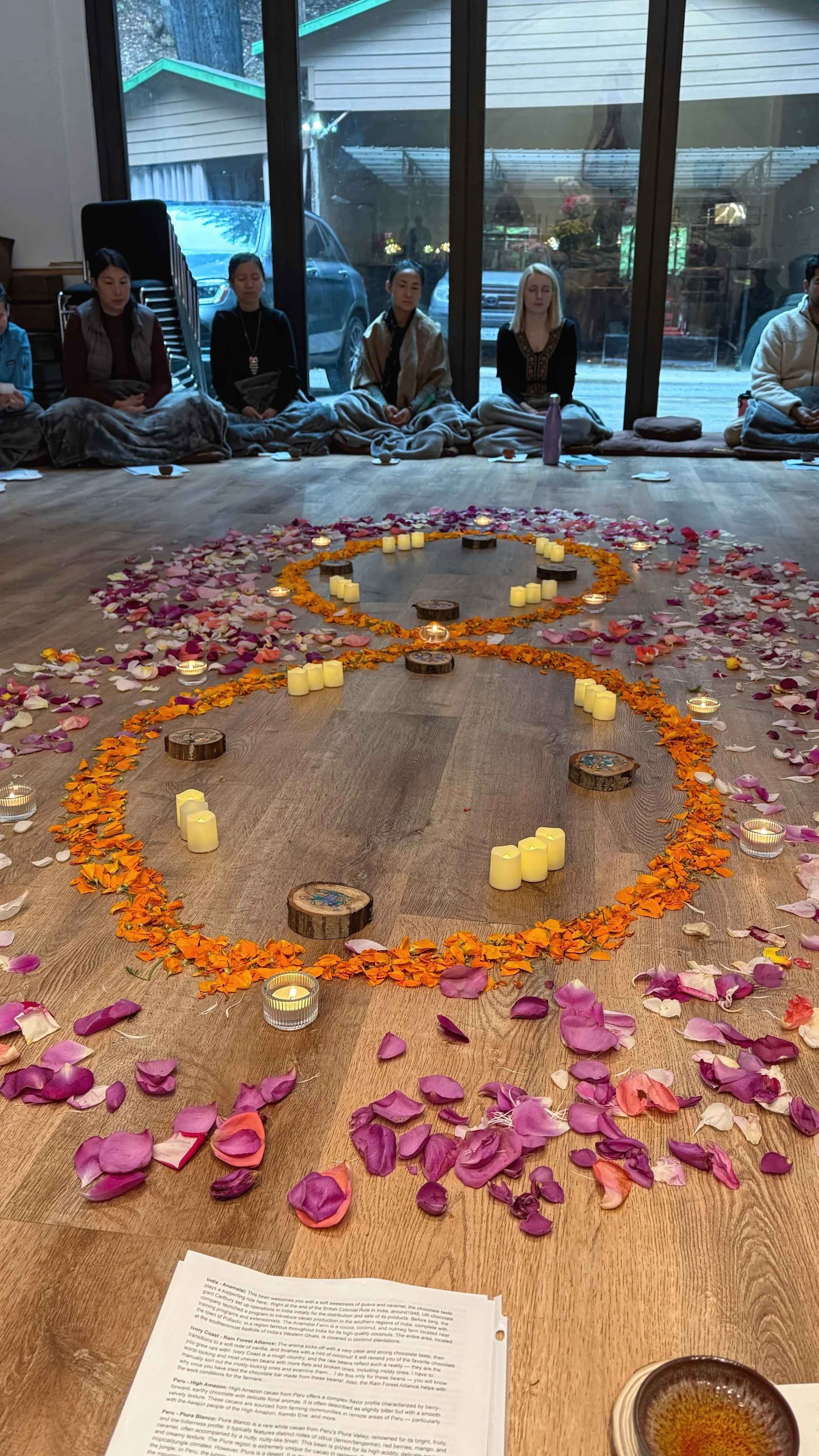
An infinity mandala on the last day.
To give from a full heart is to enjoy over and over again. The surprises and pleasure of the chocolate in my mouth. The warmth of the hand and the heart that hands me chocolate for my children. The curiosity and joy of my sons that I feel in my own body as they enjoy each piece, learning to savor the familiar to experience it anew.
During the afternoon hike, we saw how this land has been clear-cut repeatedly. Almost all the old growth redwoods in this area are gone—turned into lumber in the 19th century to meet the insatiable demands for building materials. Modernity is still haunted by the spirit of restlessness and insatiability. Driving through San Francisco on my way here, I pass a billboard capitalizing on our collective restlessness: banking for the relentlessly impatient.
Perhaps the truest and most effective response to capitalistic greed is cultivating generosity. The hand teaching the heart how to open. But to give from a full heart requires knowing—truly knowing—that we already have enough. It requires recognizing that more and less are merely ideas that we cling onto because we have not yet fully experienced what is already here: in your hand, on your tongue, hidden in plain sight all around you. Savoring allows the tongue to teach the mind that there is no need to want more.
When you realize that you have enough, the opportunities for giving can occur to you. It starts raining on the hike, just as we paused to savor another round of chocolate. Umbrellas emerge from coats and bookbags, but I’ve forgotten mine. I feel a tug on my coat, as I am pulled under the shelter of a small umbrella held by someone whose name I can’t quite recall. Three of us huddled together, no words exchanged or needed.
The saying you can’t have your cake and eat it too implies an either/or situation: either you eat your cake (but it’s gone!) or you can have it (but not taste it!). Yet the art of savoring occurs in between: the chocolate slowly melting on my tongue, slowly revealing the nuances of flavor. By the time the piece fully dissolves, it has been incorporated into the body as food, but also into the mind as a memory that activates the senses. Insatiability cannot be satiated by calories alone, but the sense of enough that enables the heart to open.